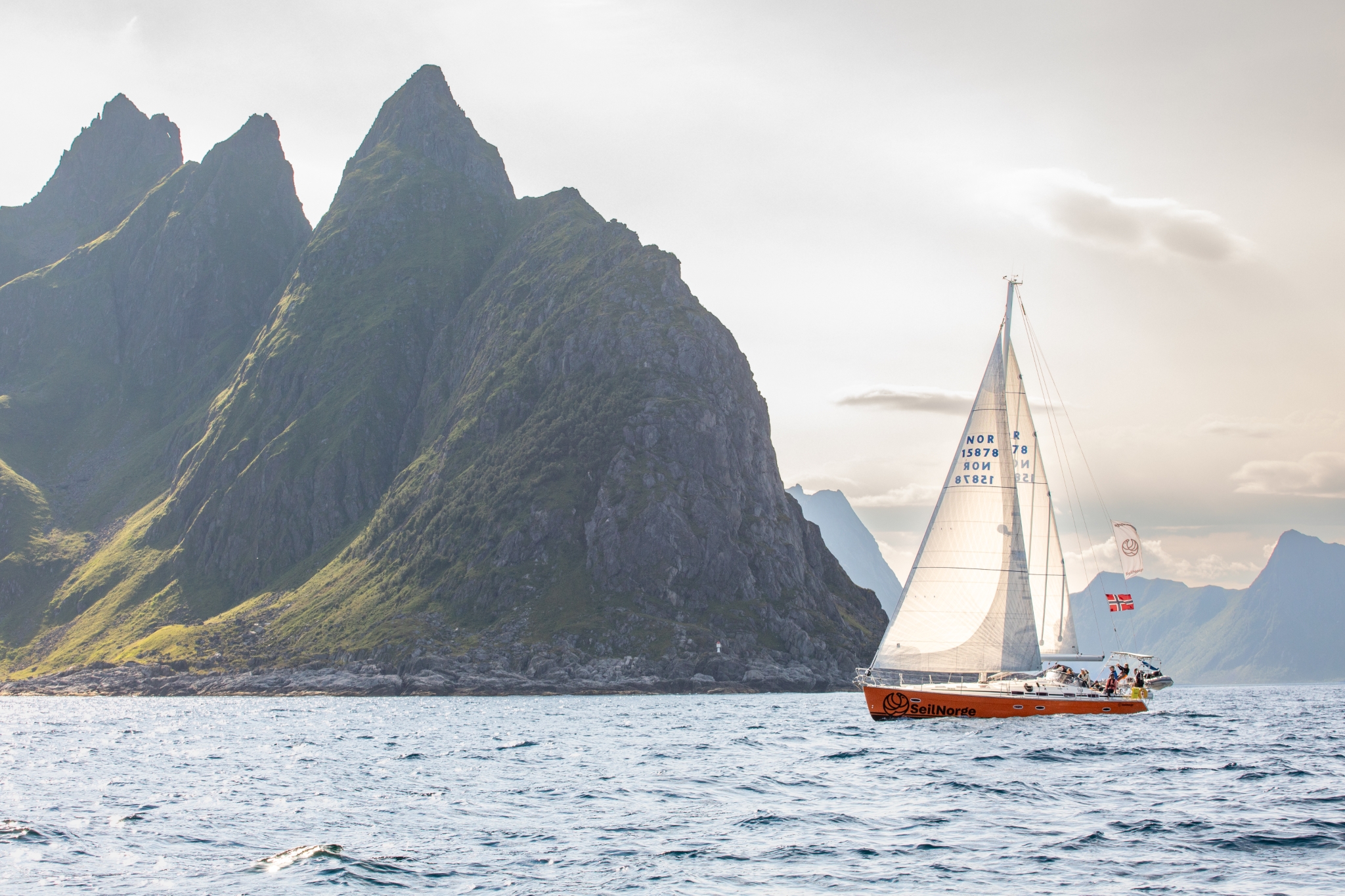
Sailing in Norway Is Possible with SeilNorge!
An old student of the Professional Degree in Sustainable Tourism in Avignon in France, Marie-Lou Blandin, set sail for Norway and now works for a tour operator specializing in sailing holidays. Drawing on her experience, she tells us how this extremely diverse professional adventure has allowed her to combine her values for more sustainable tourism with her passion for travel and wide-open spaces. Listening to her, there is only one thing we want to do: join SeilNorge and discover for ourselves the unsuspected islands and territories of the Norwegian archipelago.


From Solidarity Tourism to Norwegian Sailing
Could you introduce yourself to our readers?
I graduated in sustainable tourism in 2020, the year of Covid. I had to change all my plans and left for Norway, which was still open at the time. I moved to the small village of Nordfjordeid, between Bergen and Ålesund, on the shores of the Nordfjord. I stayed there for three years. It was there that I discovered Norwegian nature, with its fjords, glaciers, and surfing beaches. It also allowed me to integrate into the country by meeting Norwegians and gradually learning their language.
Professionally, I first took on a series of small jobs: I worked as a baker for a year and a half, then as a seasonal worker for a company offering day activities to cruise ships. I thought to myself, “I like being a baker, but I also want to discover the tourism sector—so I might as well see how things work in the cruise industry”.
That’s when I realized how predatory this system really is. The clientele of these huge ships is very mainstream; people who choose to travel with these companies are mainly attracted by low prices. Fortunately, the activities we offered did have a real positive impact on the local economy. My small personal victory was taking small groups of about ten cruise passengers hiking from Nordfjordeid. This allowed me to explain local culture, nature-based activities, village life, and to pass on a few messages about environmental protection.
I worked seasonally for two summers, then joined a kindgarden, an entirely new experience that taught me a great deal about Norwegian culture and education. This also helped me improve my Norwegian, which later proved useful during a short experience as a hotel receptionist.
The Spirit of a Human and Sustainable Adventure
How did you come to meet SeilNorge?
After a few years in Nordfjordeid, I moved to Oslo with the aim of finding a more stable job. Paradoxically, it was during a road trip with a Norwegian friend that I met SeilNorge. We were on the small island of Træna, in the north of the country, attending a music festival, and the SeilNorge team was also there. Every July, they organize a sailing trip linked to a local music festival, where travelers spend three days on site.
I managed to get hired at the Oslo agency by highlighting opportunities in the French market. At first, I helped them contact French travel agencies to sell our trips and now I’m the Key Account Navigator, in charge of all partners and agents. The work is very diverse, one of the advantages of being a small organization even though we do want to grow a bit, but in a reasonable way.

A few words to introduce SeilNorge?
In Norwegian, SeilNorge means “sailing in Norway.” The company was founded by Emil Engebrigtsen and a few friends. Emil grew up in the Helgeland region, on the small island of Ylvingen (on the west coast), between Trondheim and Mo i Rana, a beautiful area. The famous Træna Festival also takes place in Helgeland.
In 2008, Emil sailed to Træna with three friends, and it suddenly became obvious to them that it would be a great idea to promote the treasures of his region. Their idea was simple: to offer Norwegians amazing experiences in the heart of nature without having to travel to the other side of the world. The country is vast, each region is unique, and there is so much to discover.
To avoid domestic flights, which are very common in Norway, Emil also wanted to use sailing as a link between different territories. Today, he is the only founder still working at SeilNorge, but the others remain very involved in decision-making and regularly join our events or trips as skippers.
We have eight employees and work with around 30 freelance skippers. Our goal is to help Norwegians discover their own country while showing that holidays can also be used to learn a popular activity like sailing. Everyone is welcome, and you don’t need sailing experience to join our trips. The skipper involves everyone in how to hoist the sails, navigation using maps or GPS, and teamwork quickly develops.


How many travelers does SeilNorge welcome each year?
In 2025, we had 800 clients: 400 for our Ski & Sail trips, around 200 for summer trips, and the rest for our expeditions to Svalbard and Greenland, northern lights and whale watching.
Our guests are from all around the World. In winter we welcome many French, German, and American travelers, especially for Ski & Sail trips around Tromsø. We sail into the fjords, stop the boat, and then go ski touring. These trips are very popular, but there are few Norwegians, as local skiers often organize themselves. In summer, however, they join our Sail & Hike trips, which include lunches in local restaurants, visits to farms, and hiking.
Varied Trips Combining Sailing, Skiing, and Polar Exploration
What trips do you offer?
In addition to Ski & Sail and sailing to the Træna music festival (my favorite!), we offer a “Best of the Lofoten” eight-day trip with hiking, kayaking and activities, as well as a four-day version.
We are not big fans of very short trips—sailing encourages slowness and taking time. We also offer trips in the Helgeland region, which is little known among foreigners but very popular with Norwegians. Finally, we organize expeditions to Svalbard and Greenland. Most of our trips take place in northern Norway, between the Helgeland coast, the Lofoten Islands, and Tromsø.


What is life like on board the sailboats?
One of our expedition boats, Valiente, is 70 feet long (21 meters) and can accommodate up to ten passengers. On board, including the skipper, sometimes a co-skipper and a guide, there are usually 10-12 guests. Some boats include a chef, especially for private groups. Otherwise, travelers prepare meals together—it’s part of the experience.
People sleep on board in bunks, double beds, or bunk beds, with shared bathrooms. Our Expedition boats, such as Valiente, are more comfortable, with private bathrooms—still a luxury on a sailboat. Our other boats are 50 feet long and can take eight guests, or ten including skippers.
When sailing, you have to be ready to live as a community—it’s part of the adventure—but the atmosphere on board is very positive, with lots of mutual support. We welcome people of all ages and backgrounds. Many travel alone. Some belong to sailing clubs, others don’t, but a real team spirit quickly develops. And of course, we don’t forget onshore excursions.


Raising Awareness About the Fragility of Nature
Are SeilNorge’s values also about raising awareness among passengers about environmental fragility?
Absolutely. When sailing to Greenland or Svalbard, protecting nature and communicating about it is essential. Unfortunately, we increasingly see the impacts of climate change. Guides explain this, but often our clients are already aware—choosing to travel by sailboat is itself a committed act.
Our travelers understand that waste management and respectful behavior are essential. This is very different from the world of large cruise ships, where awareness-raising is still greatly needed.
Guides also explain marine ecosystems, fishing practices in Norway, and marine wildlife. By the end of the trip, travelers often realize how lucky they are to have visited such remote and unique places. Preserving the planet then becomes self-evident.

Nordic countries are known for their environmental awareness. Has SeilNorge been certified or supported in this regard?
We received some support from Innovation Norway before I arrived, but certification is not a priority at the moment. While it could help, it could also easily turn into greenwashing.
At our scale, we already communicate clearly about transport—how to reach meeting points—since all our Norwegian trips are accessible by public transport. For example, our Lofoten trip is reachable by train from Oslo to Bodø. The same applies to Helgeland. We explain this on our website.
We also encourage clients to borrow or buy second-hand gear rather than purchasing new polar or sailing equipment. Regarding food, we try to offer more vegetarian or fish-based meals. Menus are planned in advance, groceries are bought on departure day, and fish is caught during the trip. Cabin teams rotate daily to prepare meals, which involves everyone and helps reduce food waste. Leftover food is donated to charities. Waste is minimized, as recycling on board is difficult, though we recycle in ports when possible.
Wildlife Observation and Respect
How do wildlife encounters—polar bears, whales, seals, orcas—take place during your trips?
We avoid focusing solely on spotting animals. Seeing a polar bear is a privilege, but reindeer are far more numerous and play a much bigger role in local life. Our priority is to pass on respect for animals and their environment.
If we encounter whales, it’s wonderful, but we don’t go out of our way to chase them. We always keep a safe distance, which is sometimes frustrating for clients who want closer encounters. A lot of education is needed to explain that disturbing wildlife is not part of our values.
As explorer Jean-Louis Étienne reminds us during his expedition dedicated to preserving the Southern Ocean, sailing can be a powerful tool for raising awareness of our planet’s fragility.

How to get to and from Lofoten
You will offer a day sailing between Bodø and Lofoten. Can you tell us more?
Bodø is the last city before the Lofoten Islands and a key departure point. Today, a large ferry operates this route and we want to make an alternative way of getting to and from Lofoten. Inspired by initiatives like Sailcoop in Corsica, we thought it would be interesting to offer the crossing by sailboat, just like a ferry.
The crossing takes about 12 hours by sailboat. We meet in Bodø at 7 a.m. and arrive in Lofoten around 6 p.m. In summer, there is daylight until 2 a.m. We can accommodate up to nine passengers. The idea is to combine transport with learning how to sail—or simply relaxing and enjoying the scenery.
We also offer the reverse route: departing from Svolvær at 7 p.m. and arriving in Bodø overnight, with cabins available for sleeping. Crossings will run from early June to late September.
You can read more about this alternative here.

Final Thoughts
One last thing to share: a project, news, or a strong opinion?
I believe it’s extremely important to remember that a holiday can also be about learning and self-development, at any age. That’s one of the reasons I wanted to work with SeilNorge: meeting new people, sharing meaningful journeys, discovering a country without trying to see or do everything.
You shouldn’t be afraid to travel alone—our team works hard to create group cohesion and break the ice quickly.
Bonus: To encourage travelers to use public transport and challenge themselves, we’re launching a new initiative: if you travel to the Lofoten by bicycle, you can join our “4 Days in the Lofoten” trip for free. In return, we’ll simply ask for photos or videos to help us communicate. Follow us on social media—more details coming soon!
Read more about Travel Slow here.
