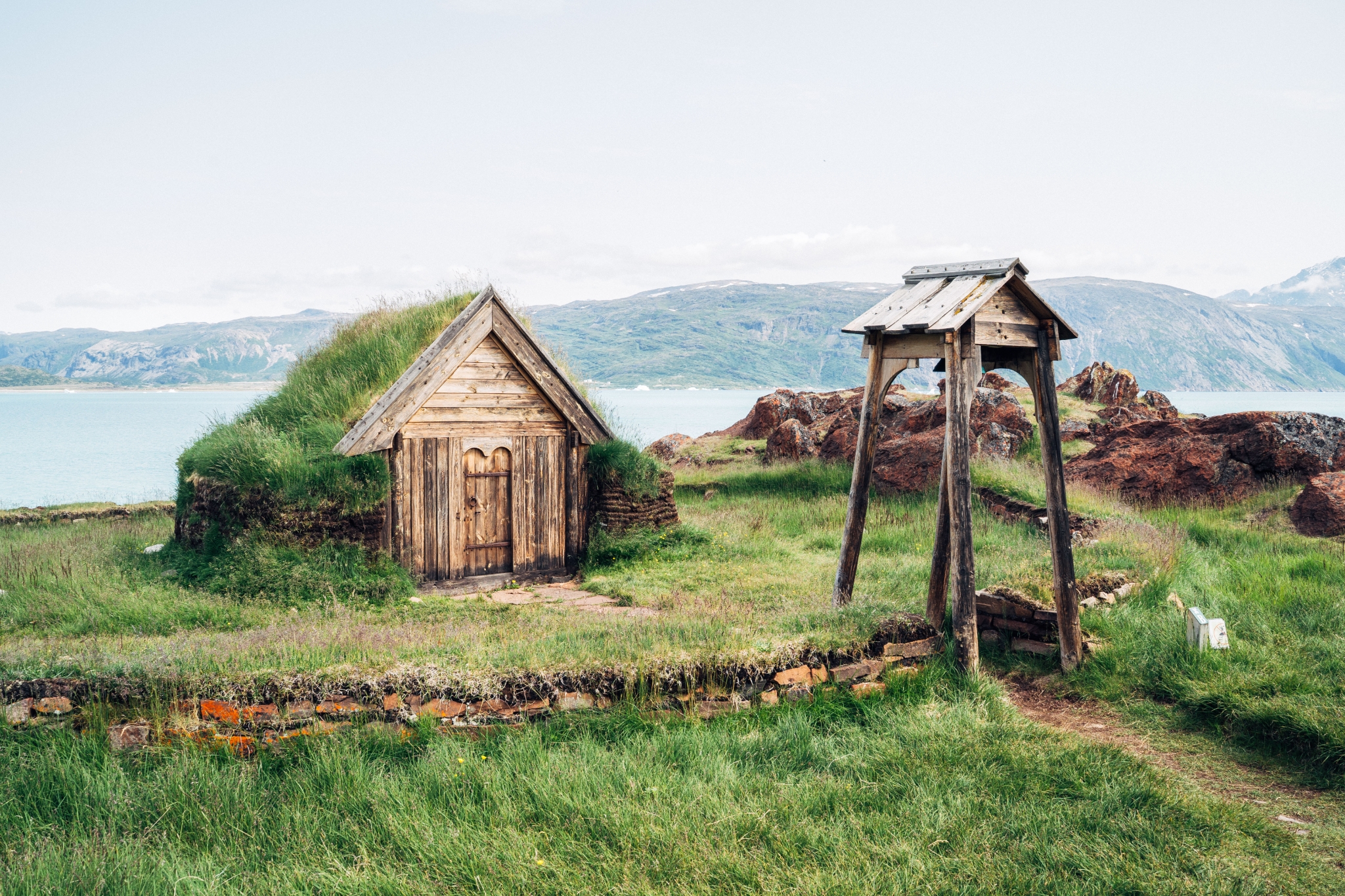
In the Spirit of Helge & Anne Stine Ingstad
As we explore Greenland we are thinking about those few that have done it before us, like Norwegian explorer, the viking Eirik the Red and author Helge Ingstad.
Helge Ingstad once said: “It is more than an adventure, it’s about exploring the virginal and the original, both in nature and in people.”
Helge Ingstad and his wife, the archaeologist Anne Stine Ingstad, spent decades investigating what happened to the Norse settlements founded by Eirik the Red around 985 AD — a society that thrived on Greenland for nearly 500 years before mysteriously vanishing in the 15th century.
Eirik the Red and how Greenland got its name
The viking, Eirik the Red, arrived to Greenland after being outlawed from Iceland in 983 AD. When he first reached the southern fjords, he found green valleys, fertile land, and mountains rising straight from the sea. Compared to Iceland, the landscape must have seemed surprisingly lush. Little did he know that around 80% of the country was covered by ice.
According to the sagas, Eirik named the land “Greenland” because he believed more people would be tempted to settle there if the country had an attractive name. And it worked. Around 985 AD, he returned with a fleet of settlers who established Norse farms deep inside Greenland’s fjords, at the very edge of the known world.
From these isolated settlements deep inside Greenland’s fjords, a new Norse society emerged at the very edge of the known world. It was from these settlements that Eirik’s son Leiv Eriksson sailed west and reached North America around the year 1000.
Leiv Eriksson Sails West – In search of Vinland
From Greenland, Leiv Eriksson sailed even further into the unknown.
Around the year 1000, nearly 500 years before Columbus crossed the Atlantic, Leiv and his crew reached the shores of North America. The sagas spoke of lands west of Greenland: Vinland. But for centuries historians debated whether the stories were myth or reality.
In 1960, Anne Stine and Helge Ingstad found what they were looking for: the remains of a Norse settlement on the northern tip of Newfoundland. The discovery confirmed it as the only known Viking site in North America — and proof that Leiv Eriksson reached the continent nearly 500 years before Columbus.
The discovery changed our understanding of history, but it also tells another story: how Greenland was once the starting point for exploration into the unknown.
In the wake of the Vikings
When we sail along Greenland’s coast today, we do so in the wake of those early explorers. Like Eirik the Red, Leiv Eriksson, and later Helge and Anne Stine Ingstad, we travel these waters under sail — moving slowly through deep fjords, between drifting icebergs and steep mountains rising straight from the sea.
Greenland still feels like the edge of the world. And perhaps that is exactly why explorers have always been drawn here.